
Class 6 Worksheet on Action Verbs vs Stative Verbs

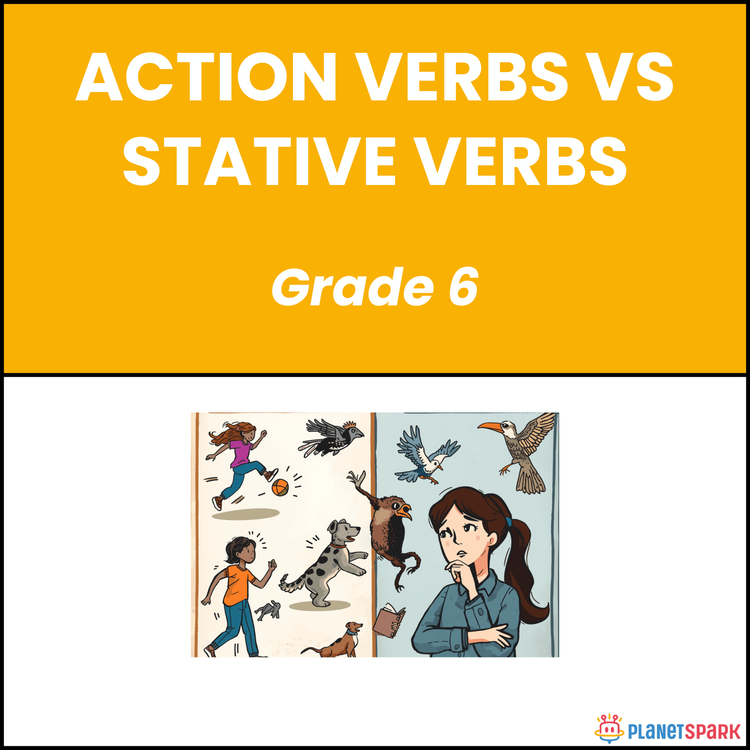
Class 6 Worksheet on Action Verbs vs Stative Verbs
"Action Verbs vs Stative Verbs for Grade 6: A Practical Grammar Mastery Worksheet"
This worksheet is designed for Grade 6 students to master the distinction between action verbs and stative verbs. It includes engaging exercises aimed at building a strong foundation in grammar and verb usage. The worksheet introduces various activities such as multiple-choice questions, true and false statements, fill-in-the-blank exercises, sentence rewriting, and paragraph corrections to reinforce the concept of action verbs and stative verbs.
The exercises are carefully designed to provide a hands-on understanding of verbs in both active and stative contexts. Through these tasks, students will be able to identify and differentiate between verbs that describe actions and those that express states or conditions. This is an essential grammar skill that students will use in writing, speaking, and understanding English more fluently.
With the activities provided, students will learn to:
- Identify action verbs and stative verbs in sentences
- Correct errors in verb usage
- Practice applying the correct verb form based on context
- Reinforce understanding through rewriting and fill-in-the-blanks
These activities will help students develop critical grammar skills that are essential for communicating effectively in English, enhancing their writing abilities and fluency.
Help your child excel in English grammar today with a Free 1:1 Communication Skills Trial Class at PlanetSpark.
Answer Key
Exercise 1 – Choose the Correct Action Verb or Stative Verb**
1. **Which sentence contains an action verb?**
a) She is running in the park.
2. **Which sentence contains a stative verb?**
b) They eat dinner.
3. **Which of the following contains an action verb?**
a) He is writing a letter.
4. **Which sentence contains a stative verb?**
a) She likes reading books.
5. **Which sentence contains an action verb?**
b) They are understanding the rules.
6. **Which sentence contains an action verb?**
b) He is running every morning.
7. **Which sentence contains a stative verb?**
a) She believes in magic.
8. **Which of the following contains an action verb?**
b) He is enjoying swimming.
9. **Which sentence contains a stative verb?**
a) They belong to the same group.
10. **Which sentence uses an action verb?**
a) They are playing football.
Exercise 2 – Identify and Mark True or False for Each Statement Based on Action and Stative Verbs
1. T – She writes letters every day.
2. T – They are studying for the test right now.
3. F – They belong to the same school club (Stative verb: "belong" is not an action verb).
4. F – They are knowing the answer to the question (Incorrect usage of stative verb "know").
5. T – I understand the concept completely.
6. T – He believes in ghosts.
7. T – They are watching a movie together.
8. T – He feels sick today.
9. F – She is liking her new job (Incorrect usage of stative verb "like").
10. T – She knows how to play the piano.
Exercise 3 – Fill in the Blanks
1. play
2. feels
3. like
4. understands
5. wait
6. believe
7. played
8. likes
9. know
10. enjoy
Exercise 4 – Rewrite the Sentences by Correcting the Errors
1. She enjoys reading mystery novels.
2. The students understand the lesson clearly.
3. He seems confident about the project presentation.
4. They believe in the power of teamwork.
5. We knew the answer to the question.
6. They are planning their weekend trip.
7. He hears the birds singing outside.
8. We think that the movie was fantastic.
9. She is looking at the artwork with admiration.
10. They are working on their assignments together.
Exercise 5 – Correct the Errors in the Following Paragraph
The corrected paragraph is:
She knows the answer to the question. He feels the cold weather outside and is thinking about how to get home. They are seeing a movie tonight and think it will be very exciting. I believe that we will win the game. The children are playing in the park while their parents are waiting for them. We know the importance of studying hard for exams. She likes the new book she bought last week.
Frequently Asked Questions
Action verbs describe actions (e.g., run, jump), while stative verbs describe states of being or conditions (e.g., is, feel).
To ensure correct verb tense usage, specifically avoiding the incorrect use of continuous (-ing) forms with states, feelings, or possession
By using picture cues and matching exercises to anchor each sound visually.