
Class 7 English Worksheet on Turning Point in Story

Class 7 English Worksheet on Turning Point in Story
Turning Points (Key Moments) for Grade 7
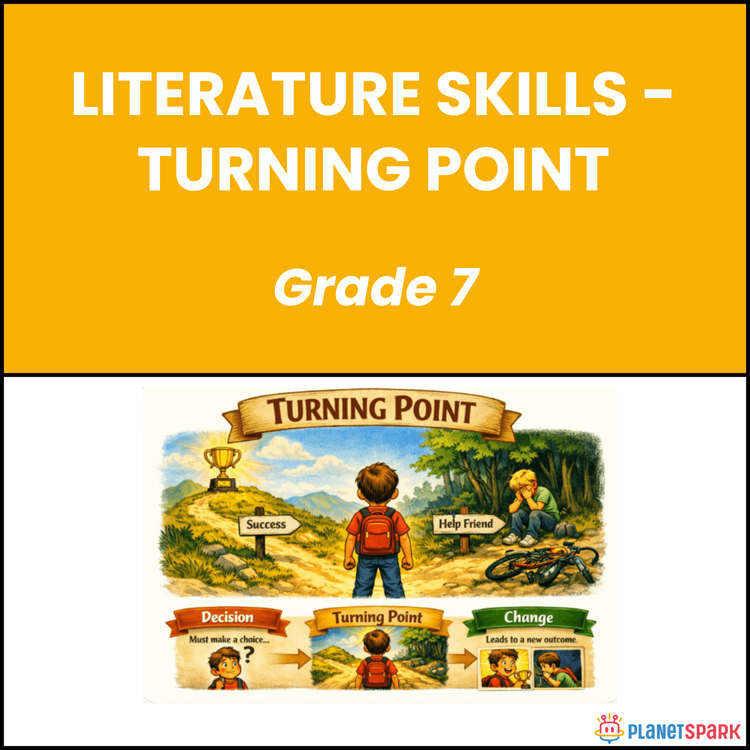
This Grade 7 English worksheet helps students understand key moments, or turning points, in stories. Turning points are pivotal events that change the course of a narrative, leading to new outcomes and character growth. Through engaging exercises like multiple-choice questions, true/false statements, fill-in-the-blanks, and paragraph writing, students will enhance their ability to identify and analyze these crucial moments in literature.
Why Turning Points Matter in Plot Development?
1. Helps students recognize key moments that alter the direction of the story.
2. Encourages deeper understanding of how decisions, events, and changes affect the plot and characters.
3. Enhances students' ability to create compelling stories by incorporating turning points.
4. Supports better comprehension of how turning points move the story forward and build tension.
What’s Inside This Worksheet?
🧠 Exercise 1 – Multiple Choice Questions
Students choose the correct turning point based on the situation described.
✔️ Exercise 2 – Fill in the Blanks
Students complete sentences by filling in the blanks with the correct word related to turning points.
✏️ Exercise 3 – True or False
Students determine whether the given statements about turning points are true or false.
🔍 Exercise 4 – Sentence Underlining
Students read sentences and underline the key moment, then circle the action that defines the turning point.
📝 Exercise 5 – Paragraph Writing
Students read a passage and explain how turning points affect the direction and outcome of the story.
Answer Key
Exercise 1 – Multiple Choice
1. c) Character choice
2. b) Character hesitation
3. a) Character choice
4. b) Background detail
5. a) Character choice
6. a) Flashback
7. c) Character choice
8. a) Setting change
9. b) Side detail
10. c) Background detail
Exercise 2 – Fill in the Blanks
1. turning point
2. climax
3. crisis
4. revelation
5. motivation
6. transformation
7. conflict
8. pivotal moment
9. consequence
10. turning point
Exercise 3 – True or False
1. True
2. False
3. False
4. True
5. True
6. True
7. False
8. False
9. True
10. False
Exercise 4 – Sentence Underlining
1. Key Moment: "He chose to confess the truth to his teacher." — Action: "confess"
2. Key Moment: "She agreed to help her friend in trouble." — Action: "agreed"
3. Key Moment: "He changed his plan after hearing the news." — Action: "changed"
4. Key Moment: "She accepted the challenge despite fear." — Action: "accepted"
5. Key Moment: "Ravi selected a new path during the journey." — Action: "selected"
6. Key Moment: "He refused to follow the unfair rule." — Action: "refused"
7. Key Moment: "She made a promise that changed everything." — Action: "made"
8. Key Moment: "He ignored the warning and continued walking ahead." — Action: "ignored"
9. Key Moment: "Riya spoke up during the meeting." — Action: "spoke up"
10. Key Moment: "He selected a different path at the crossroads." — Action: "selected"
Exercise 5 – Paragraph Writing
Turning Point 1: "Ravi was nervous before the final match and wanted to quit."
Turning Point 2: "At the last moment he decided to play with confidence."
Effect of Turning Points: "This decision changed his performance and helped his team win."
Cause and Effect: "The crowd cheered as his energy lifted the spirit of his teammates. Each move he made showed determination instead of fear. The opposing team struggled to keep up with his renewed pace."
Resolution: "By the end, Ravi’s courage had turned the match into a memorable victory for everyone watching."
Build your child’s understanding of turning points and their impact on the plot!
Book a free trial!
Frequently Asked Questions
A turning point is a key moment where the story changes direction, often leading to the climax in English worksheets.
Students can look for major changes in character decisions or events that shift the story’s outcome.
It helps early learners understand story structure and recognize how conflicts lead to resolution in CBSE English.